
Latin Heritage Month art projects are a chance to celebrate culture, identity, and representation in elementary and middle school art. Seeing artists who share their background builds pride and connection. Meeting artists from other cultures builds empathy and curiosity.
As art teachers, we know kids are hard to engage these days. That’s why these projects are simple, hands-on, and flexible. And the best part? They highlight living and historic Latin voices that bring fresh ideas into your art lessons! But if you need suggestions for Hispanic artists, I have a lot of thoughts on that topic, too.
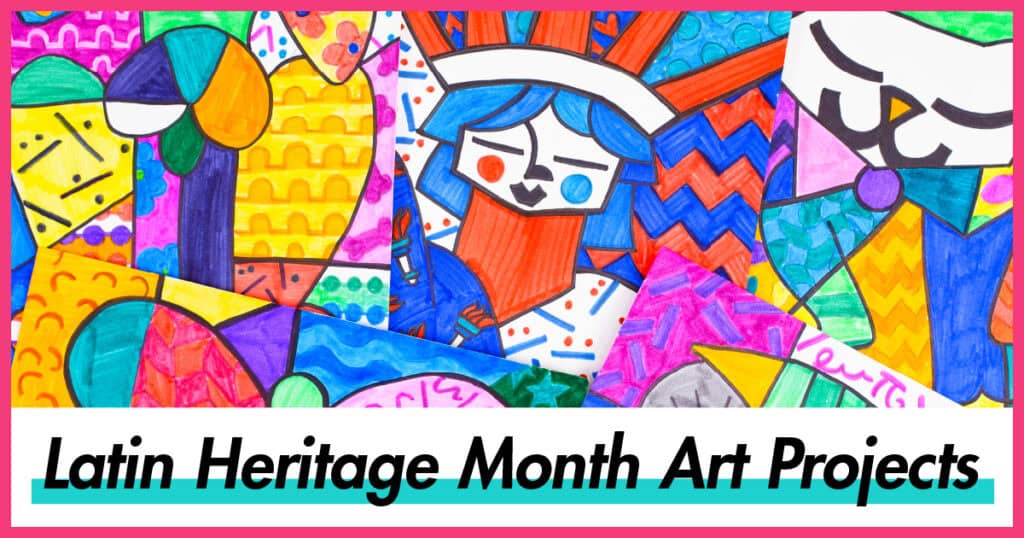
15 Contemporary Latin Heritage Month Lesson Ideas for Elementary and Middle School
These Latin Heritage Month art projects are artist-led and kid-approved. I’ve centered this post on Latin heritage artists who lean into identity, culture, and voice. I’m spotlighting bold colors, playful media, and pop-culture ties. They’re sure to pull kids in fast.
Specifically, these artists come from Mexico, Brazil, Colombia, Puerto Rico, Cuba, the Dominican Republic, Guatemala, Peru, Chile, Argentina, and Venezuela. Moreover, they include Latin heritage painters, sculptors, and muralists beyond October to keep your art curriculum fresh and relevant.
1. Romero Britto
Romero Britto is a Brazilian pop artist known for his strong palette, thick black outlines, and playful patterns. He’s one of my favorite Latin Heritage Month artists because art projects are any easy muse. His canvases and sculptures mix Cubist shapes with cheerful subjects. Think hearts, flowers, and animals. Britto’s artwork can be found on murals, toys, and sneakers.
I feel that Britto’s style is perfect for elementary kids, especially grades 2–5. Younger kids connect with the bright colors and cartoon-like outlines. While older children enjoy playing with overlapped shapes and patterns.

Art Project Ideas
- Compose a patterned heart or animal with bold outlines. Fill each section with stripes, dots, or checks in bright hues.
- Create a Pop Art self-portrait by tracing a simple face outline. Next, divide it into sections. Then add strong hues and patterns.
- Make a collaborative mural where each student colors a square in Britto’s style.
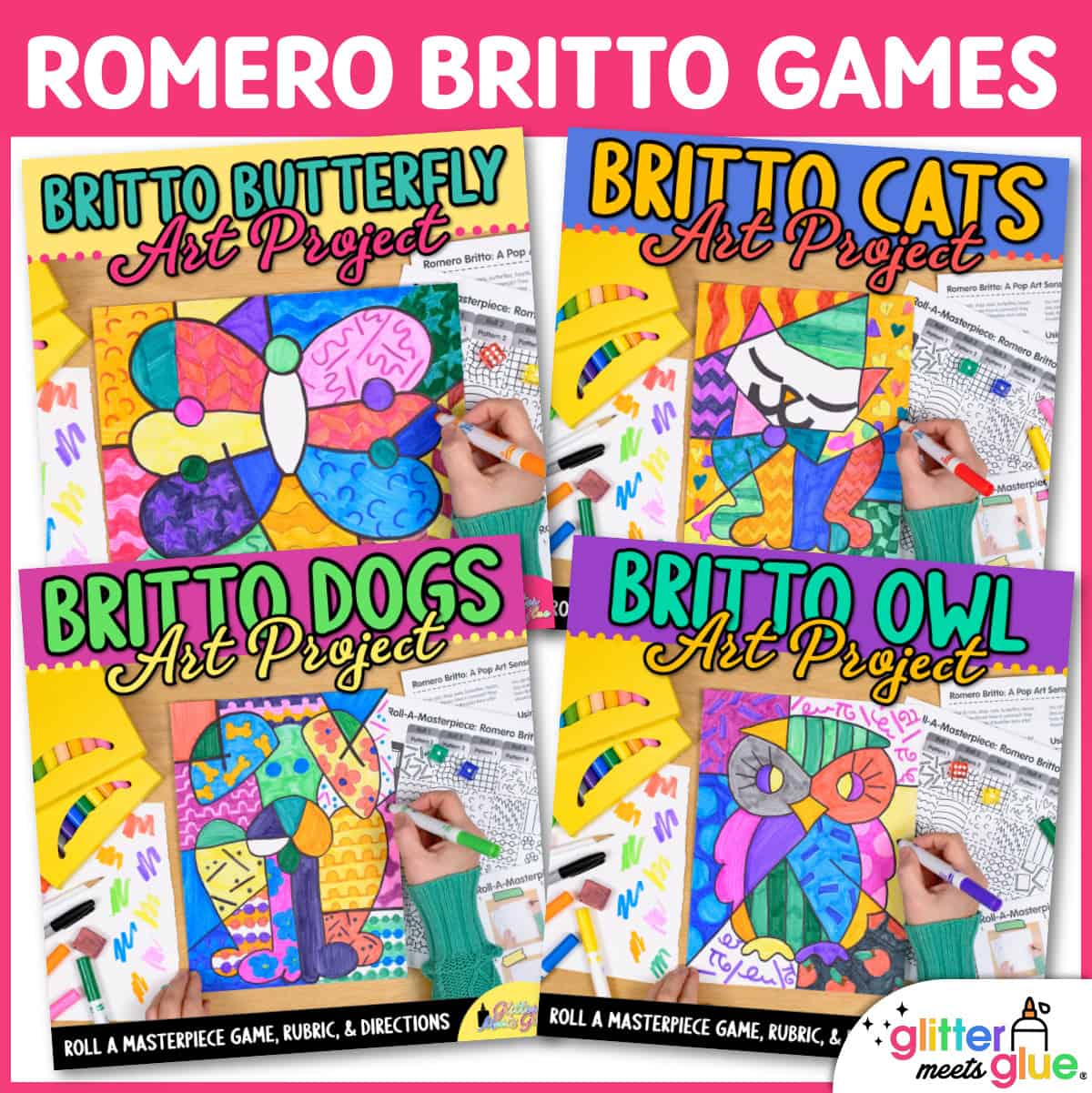
Shop This Post!
Romero Britto Art Game Bundle
Original price was: $19.96.$15.99Current price is: $15.99.
More Info2. Carlos Cruz-Diez
Carlos Cruz-Diez was a Venezuelan Op artist best known for optical and kinetic art. Specifically, he created large-scale immersive installations of lines and color strips. They seem to move as you move. He believed color wasn’t just decoration. It was an experience you could step into. As a result, his installations and paintings shift as you walk by. New hues appear depending on your angle.
In the classroom, Cruz-Diez’s art is a great fit for middle schoolers who love puzzles and optical illusions. For instance, his ideas work well for teaching color theory, contrast, and how spacing and line direction affect perception. He’s a more unexpected Latin heritage month voice to bring into the art room in October. But one I think middle schoolers will enjoy.

Art Project Ideas
- Create an optical stripe design with evenly spaced lines and alternating warm and cool hues. Focus on making a vibrating effect.
- Make a “color corridor” by lining a hallway with paper strips in different color families. The hues should shift as kids walk past.
- Design an agamograph paper sculpture by cutting a drawing into strips. Next, mount it on paper folded accordion-style. Then add a second image to reveal as viewers move.
3. Tarsila do Amaral
Tarsila do Amaral was a Brazilian modernist painter often called the “mother of modern art in Brazil.” Specifically, she combined Cubist shapes with Brazilian folk themes. Her paintings felt both local and international. Her canvases often show simple figures, bright colors, and dreamlike landscapes. When you think of art projects for Latin Heritage Month, Do Amaral should definitely come to mind.
Do Amaral’s work fits well in both elementary and middle school classes. For example, younger kids enjoy her playful shapes and bold hues. Meanwhile, older students connect with themes of cultural identity and pride in her Latin heritage.

Art Project Ideas
- Draw a surreal landscape with oversized plants, animals, or figures. Use bold hues and simple shapes, like Do Amaral.
- Create an “Abaporu-inspired” figure with exaggerated features. Draw big feet, long arms, small heads in a background of personal symbols.
- Make a collaborative mural where each student adds a surreal figure, plant, or animal. Assemble them into a patchwork mural.
4. Joaquin Torres Garcia
Joaquín Torres-García was an Uruguayan painter, sculptor, and teacher who developed “constructive universalism.” Specifically, he used grids filled with symbols for everyday life, Latin culture, and community. These icons (boats, suns, houses, people) sit in geometric layouts. In other words, simple shapes become a visual language with big ideas.
In the classroom, his paintings are especially doable for elementary. Moreover, upper elementary kids can invent symbols and place them in a grid. Meanwhile, kindergarten and first grade can explore primary colors with dynamic lines. Garcia’s work is a great example of approachable Latin art.

Art Project Ideas
- Design a personal symbol grid with simple icons representing hobbies, foods, or traditions. Arrange everything in bold lines and flat primary colors.
- Make a class mural of community symbols by combining student-made squares into a large grid, Each piece should tell the story of the group.
- Create a “symbol story” collage. Arrange abstract shapes and invented icons to show how simple forms can carry meaning.
5. LeDania (Diana Ordonez)
LeDania is a Colombian street artist from Bogotá known for her large, chromatic murals. Specifically, her art features animals, insects, mythological figures, and fantasy imagery. She mixes Latin symbols, patterns, and vibrant palettes. The result: dreamlike, almost magical scenes. In addition, she works in photography, graphic design, and decorative art.
LeDania’s art is a natural fit for Latin Heritage Month for both elementary and middle school. For example, younger children connect with her bright Latin-infused palette and animal imagery. While older students enjoy exploring symbolism and layered meaning.
All in all, her artwork is a strong entry point for Latin street art and identity. It also shows how murals bring positivity to her community.

Art Project Ideas
- Draw a fantasy animal with bold outlines and fill it with repeating symbols or patterns inspired by LeDania’s murals.
- Design graffiti-style lettering of a student’s name or a positive word using bright, layered hues.
- Draw a layered spirit mask on black paper with smudged soft pastels for glowing color fields. Add lines, eyes, and symbols with white/metallic gel pens and acrylic paint markers.
6. Marisol Escobar
Marisol Escobar was a Venezuelan-born sculptor who became known simply as “Marisol.” Specifically, she created wooden, figurative sculptures that often mix painting, drawing, and found objects. Her portraits can be playful or satirical and sometimes critical of society and politics. As a result, her sculptures blur the line between fine art and pop culture.
In the classroom, her work fits middle schoolers ready to explore identity and use art to speak on their world. For example, upper elementary can enjoy the bold, blocky look by building simplified portrait projects. Overall, it’s a friendly way to introduce portrait-as-sculpture and social ideas.

Art Project Ideas
- Build a 3D portrait using cube and rectangular prism paper templates. Add drawn or painted details in Marisol’s style.
- Create a family or friend group sculpture. Combine several blocky figures decorated with everyday materials.
- Make a portrait box using cardboard boxes. Each side shows a different mood or role a person plays.
7. Gonzo247 (Mario Enrique Figueroa Jr.)
Gonzo247 is a Mexican-American graffiti artist based in Houston, Texas. Specifically, he’s known for punchy lettering, large-scale murals, and Latino community-focused street art projects. His work combines bold letters, layered colors, and playful energy. And it celebrates identity and pride. In addition, he’s a vocal advocate for graffiti as a positive force in the Latino community.
Gonzo247’s style works for both elementary and middle school. For example, younger kids love the letter art and color play, while older children can try tags, throwies, and bubble letters. All in all, it’s an easy way to talk about voice, place, and public art.

Art Project Ideas
- Draw bubble or wild-style letters of a child’s name, filling them with bright patterns and outlines.
- Design a positive word poster in graffiti style, spreading messages like “hope” or “kindness.”
- Create a class graffiti wall on butcher paper where each child contributes a tag or design.
8. Suely Blot
Suely Blot is a Brazilian–French painter who is self-taught and works primarily with acrylics and pigments on large canvases. Color drives her process. Sometimes it’s bold and saturated. Other times it’s soft and pastel. Also she often combines painted passages with written/gestural marks. Alongside pure abstracts, she also paints floral still lifes with energetic brushwork. As a result, the work reflects her dual Brazilian–French identity. It also shows a love of trying new things.
In the classroom, Blot’s artwork fits middle school when you want students to loosen up, layer materials, and lead with color choices. For example, it’s great for units on color families and expressive mark-making. Meanwhile, her floral still-lifes are perfect for practicing observation without getting stuck on tiny details.

Art Project Ideas
- Paint a seasonal color study with thin layers, then add quick gestural lines and words on top.
- Create an expressive floral still life from a bouquet or photo. Block in large shapes first, then add energetic marks to suggest petals and stems.
- Make a mixed-media texture panel by laying down acrylic color fields, scratching into wet paint, and finishing with pastel or pencil marks for contrast.
9. Farid Rueda
Farid Rueda is a Mexican muralist known for painting animals filled with bright hues and detailed patterns. Specifically, his murals often feature jaguars, owls, and other symbolic Latin-inspired creatures. They tie into his Mexican heritage and folklore. He uses repeating motifs and vivid hues to represent cultural identity and pride. In short, his work appears on walls across Mexico and internationally.
In the classroom, Rueda’s art resonates with both elementary and middle school. For example, younger students love the animal imagery, while older kids connect to the cultural symbolism. All in all, his style is great for teaching color families, patterns, and the idea of art as storytelling.

Art Project Ideas
- Draw a symbolic animal and fill it with repeating patterns in bright hues, similar to Rueda’s murals.
- Design a mask inspired by Mexican culture, using strong outlines and vibrant patterns to represent personality.
- Make a class mural of animals where each student contributes a patterned creature that reflects community pride.
10. Mart Aire
Mart Aire is an Argentine muralist. At age 12, he painted train cars in Buenos Aires alongside Latin graffiti writers. Today, he paints surreal, dreamlike scenes with fine, loose strokes of spray and latex paint. His murals are all done freehand. In these works, human figures float among patterns, plants, and imagined spaces. As a result, the hues feel lush and energetic, and the mood is playful and otherworldly.
In the classroom, Mart’s murals are best for middle school, with options for upper elementary. For example, students can mix realism with fantasy in safe, scaffolded steps. All in all, it’s a solid bridge to symbolism and personal storytelling. And a fun additional to your art curriculum for Latin Heritage month.

Art Project Ideas
- Draw a surreal self-portrait on a bike in Mart’s style of floating shapes, patterned skies, and bold, dreamy hues.
- Compose a dreamscape mixing figures, plants, and patterned skies.
- Make a layered collage combining magazine elements and hand-drawn details.
11. Eamon Ore-Giron
Eamon Ore-Giron is a modern Peruvian-American artist who paints geometric abstractions that seem to carry a beat. His canvases use repeated shapes, crisp edges, and warm–cool contrasts. Ore-Giron finds ideas in Latin American textiles, gods, and goldwork. Many of his canvases feel musical and calm all at the same time.
His style suits middle school and touches upon math concepts like shape, symmetry, and pattern. In that sense, it pairs well with Kandinsky’s work. Both show how geometry and color create rhythm.

Art Project Ideas
- Create a geometric composition using two color families and repeating forms.
- Design a paper “quilt” of cut shapes arranged into rhythmic patterns.
- Make a mural panel that combines simple geometry with a personal symbol.
12. Aliza Nisenbaum
Aliza Nisenbaum is a Mexican-born painter known for large, bold portraits. Specifically, she paints friends and community members with patterned settings and attentive detail. Her artwork centers respect, care, and everyday stories. As a result, the canvases feel intimate and welcoming.
These portraits fit both elementary and middle school. For example, younger students can paint a classmate with a patterned background. Meanwhile, older students can discuss representation and why it matters. In short, it’s a strong unit for community connections during Latin Heritage month.

Art Project Ideas
- Paint a partner portrait with a patterned fabric or wallpaper background.
- Create a group portrait showing classmates in a shared space.
- Compose a “community helper” portrait that honors someone local.
13. Eduardo Kobra
Eduardo Kobra is a Brazilian street artist famous for massive, rainbow-colored portraits. Specifically, he blends geometric patterns with realistic faces to striking effect. His murals appear on city walls across Latin America and around the world. Many celebrate cultural icons and shared history.
Kobra’s approach works well for K–8. For example, elementary students can color portraits with bold sections and patterns, while middle schoolers tackle value, scale, and layout. Overall, it’s a strong way to talk about public art.

Art Project Ideas
- Create a Kobra-style portrait. Print a black-and-white photo of the student. Then add bold geometric color blocks and patterns with markers or paint. Keep key facial features visible.
- Make a collaborative portrait mural in the style of Mount Rushmore using photos of student faces painted with washes of acrylic or tempera paints.
- Design a famous-figure portrait using geometric blocks, bright hues, and high contrast.
14. Mono González (Alejandro González)
Mono González is a Chilean muralist known for bold outlines, flat hues, and graphic forms. Historically, his work grew alongside social movements and community projects in Latin America. Many murals speak to memory, pride, and collective identity. Also, he creates drawings, engravings, woodcuts, and silkscreen prints.
González’s style is friendly for K–8 art projects. For example, younger children can focus on clear shapes and color blocks, while older students design posters about community values. Overall, it’s a natural fit for art-and-activism lessons.

Art Project Ideas
- Draw a side-view portrait with thick black outlines and flat, bright color blocks in Mono’s style.
- Design a bold poster for a community value using simple shapes and 2–3 strong hues.
- Make a class mural panel showing a figure surrounded by unity symbols; combine panels into one graphic wall.
15. Elliot Tupac
Elliot Tupac is a Peruvian lettering artist and printmaker known for neon-bright typography. His posters and murals use bold words, gradients, and high contrast. The style comes from Latin “chicha” poster traditions and street culture. His messages often feel upbeat and strong.
I feel Tupac’s artwork is fitting for upper elementary and middle school. Kids love learning unique ways to draw letters, especially their name or empowering words. But I’d also consider using him as a muse for any digital art projects for Latin Heritage Month, too! Use them to teach graphic design, layout, and positive messaging.

Art Project Ideas
- Design a positive word poster with bold hand lettering and gradients.
- Create a name design using outlined letters and high-contrast fills.
- Make class message panels where each student contributes one word.
Go deeper with artist-led, choice-heavy projects.
For example, try Cruz-Diez/Soto optical or kinetic builds, a Torres-García symbol grid about identity, or an Angel Otero paint-skin collage using torn painted papers.
Or, run a Kobra portrait by layering color blocks over a black-and-white photo, or a community portrait in the spirit of Aliza Nisenbaum. Typography fans can tackle Elliot Tupac posters with bold lettering and gradients.
Yes! Teach Latin artists all year, not just in one month. It keeps representation real instead of a “one-and-done” unit. Their work fits tons of core lessons: color, portraiture, abstraction, murals, and community art. Plus, kids connect to living voices and family stories. That connection bumps up buy-in and effort.
In the end, kids need to see themselves reflected throughout the school year, not just in October.
I start with the artist’s own site or museum page, keep the bio short, and make sure I’m saying names correctly.
I skip stereotypical Latin crafts. Instead, I let kids pick their own symbols, colors, and stories so no one feels labeled. When I’m unsure, I ask myself: ‘Does this honor the artist and our community?’ If a student isn’t comfortable, I offer a different option with the same skills but a different subject. I end with a quick reflection about what their choices say
How Will You Honor Latin Heritage Month in Your Art Room?
And that’s the list. Latin artists with big color, clear ideas, and kid-friendly entry points. I’m excited to design a few new Latin Heritage Month art projects this year. I’ll keep the artist credit visible, give kids real choice, and let their symbols and stories lead.
Use what fits your grade level and your school. For example, maybe it’s a Kobra-style portrait, a Torres-García symbol grid, or a Nisenbaum partner portrait. Mix and match. Moreover, teach these Latin artists past October so it feels real, not a one-and-done unit.
So, art teachers, what’s your plan? Which Latin artists and art projects are you bringing in first for Latin Heritage Month? What did I miss that your students love? Drop a comment and share your best ideas!
Leave a Comment